One in three couples scores below 18 in kundli matching — the same share chance predicts
GrahAI recomputed the Ashtakoot scores of 1,946 couples checked on its matching tool and compared them with every possible pairing of Moon positions. The two are statistically indistinguishable.
By Rahul Dubey, Founder, GrahAI
Published
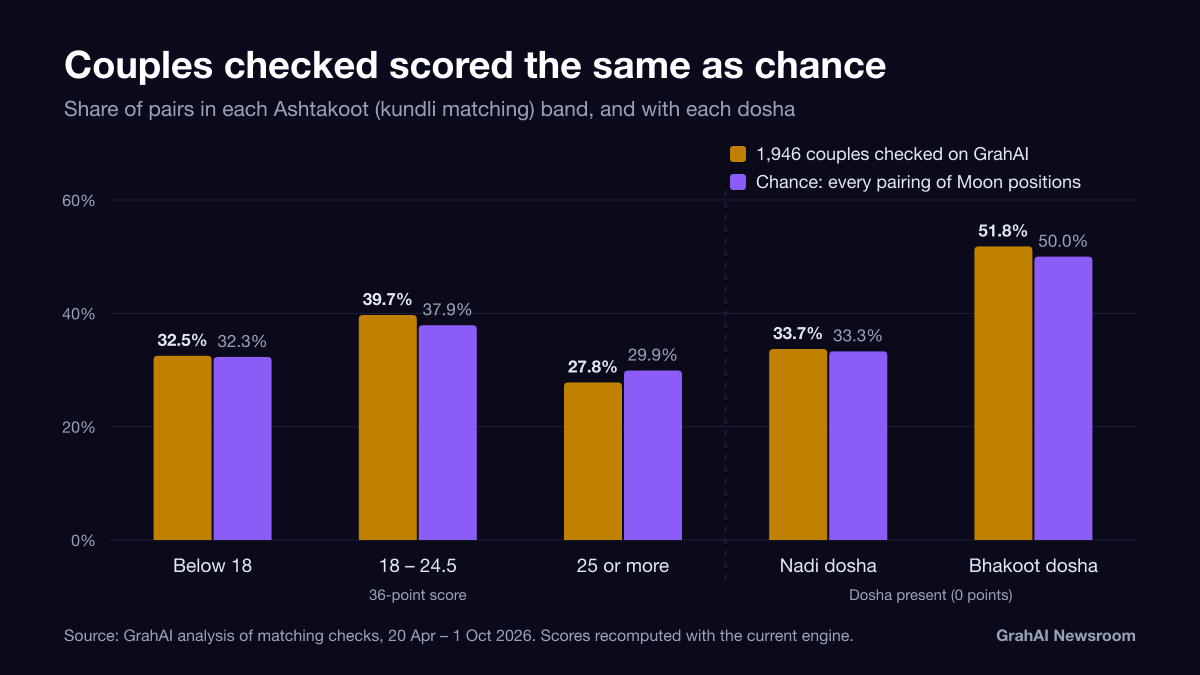
Between 20 April and 1 October 2026, people checked 1,946 distinct couples on GrahAI’s free kundli matching tool. When every one of those scores was recomputed and set beside the scores of random pairs, the two distributions came out almost exactly the same.
A third of the couples — 32.5% — scored below 18 of 36 points, the line many families treat as the minimum for a match. Pair up Moon positions entirely at random and 32.3% fall below 18. A third of the couples (33.7%) also had Nadi dosha, against 33.3% at random.
| Couples checked | Chance | |
|---|---|---|
| Average score (of 36) | 20.36 | 20.48 |
| Median score | 21 | 21 |
| Below 18 | 32.5% | 32.3% |
| 18 to 24.5 | 39.7% | 37.9% |
| 25 or more | 27.8% | 29.9% |
| Nadi dosha (0 of 8 points) | 33.7% | 33.3% |
| Bhakoot dosha (0 of 7 points) | 51.8% | 50.0% |
What the numbers show
Across the three score bands, the difference between real couples and chance is not statistically significant (chi-square 4.69 on 2 degrees of freedom, p = 0.096). The share below 18 carries a 95% margin of error of about ±2.1 percentage points, and the chance figure sits well inside it. The one visible gap — slightly fewer couples at 25 or more, 27.8% against 29.9% — does not survive the overall test.
What it does and does not mean
Our reading: the couples people bring to a matching tool look, on this score, like any two people. Whatever brings them together — a family introduction, a matrimony profile, friendship or love — is not, on this evidence, selecting for Moon-sign compatibility before the check is run.
It also means a low result is ordinary. By chance alone one pairing in three falls below 18 and one in three has Nadi dosha; about half of all pairings have Bhakoot dosha. A family seeing one of these results is seeing what a third — or half — of all pairings would show.
It says nothing about whether matching predicts how a marriage turns out. There is no outcome data here, and none is implied. The 36-point figure is also the raw Ashtakoot total, before the traditional exceptions (parihara) an astrologer weighs, which can cancel a dosha.
How the analysis was done
- Data: every compatibility check run on GrahAI’s matching tool from 20 April to 1 October 2026, excluding GrahAI’s own internal and test accounts — 2,332 checks. Repeat checks of the same two sets of birth details were counted once, leaving 1,946 distinct couples.
- Scores: recomputed for every couple with GrahAI’s current matching engine, from each person’s Moon nakshatra and Moon sign — the only inputs the eight Ashtakoot factors use — so every couple is scored by the same rules, including the Graha Maitri table revised on 1 October 2026.
- Chance: every pairing of Moon positions on a half-degree grid around the zodiac, 518,400 pairs, scored by the same engine. The Moon circles the zodiac every 27 days, so across many birthdays its position is spread almost evenly; this is what pairing people at random produces.
- Test: chi-square goodness of fit across the three score bands; 95% margins of error by the normal approximation.
- Privacy: only aggregate counts were produced. Birth details were used in memory to recognise repeat checks and were not exported, and no individual couple is described.
Limitations
- We do not know who the two people are to each other — engaged, married, weighing a proposal, or simply curious — and some people check several possible partners.
- These are people who chose to use GrahAI, mostly in India. They are not a sample of all couples.
- Matching calculators differ on some conventions, notably Graha Maitri and Bhakoot, so another calculator can score the same pair slightly differently.
- Ashtakoot is one layer of compatibility analysis, and this study looks at that layer alone.
The same check can be run for any two birth charts on GrahAI’s free kundli matching tool, and the matching guide shows how each of the eight factors is scored.
How this article was made
The figures come from a read-only analysis script run against GrahAI’s own records for the fixed window above; the chart is drawn from the same output. Drafting was AI-assisted, every figure was checked against that output, and Rahul Dubey reviewed the article before publication.
Written by
Founder, GrahAI
Rahul Dubey is the founder of GrahAI. He leads the product — the chart engine, the AI-written reports and the free tools on this site — and writes the company’s announcements and product notes in this newsroom.