One in four questions people ask an AI astrologer is about “when”
An analysis of 10,432 questions typed to GrahAI’s AI astrologer between April and October 2026: what people ask about, how often they ask when, and which script they type in.
By Rahul Dubey, Founder, GrahAI
Published
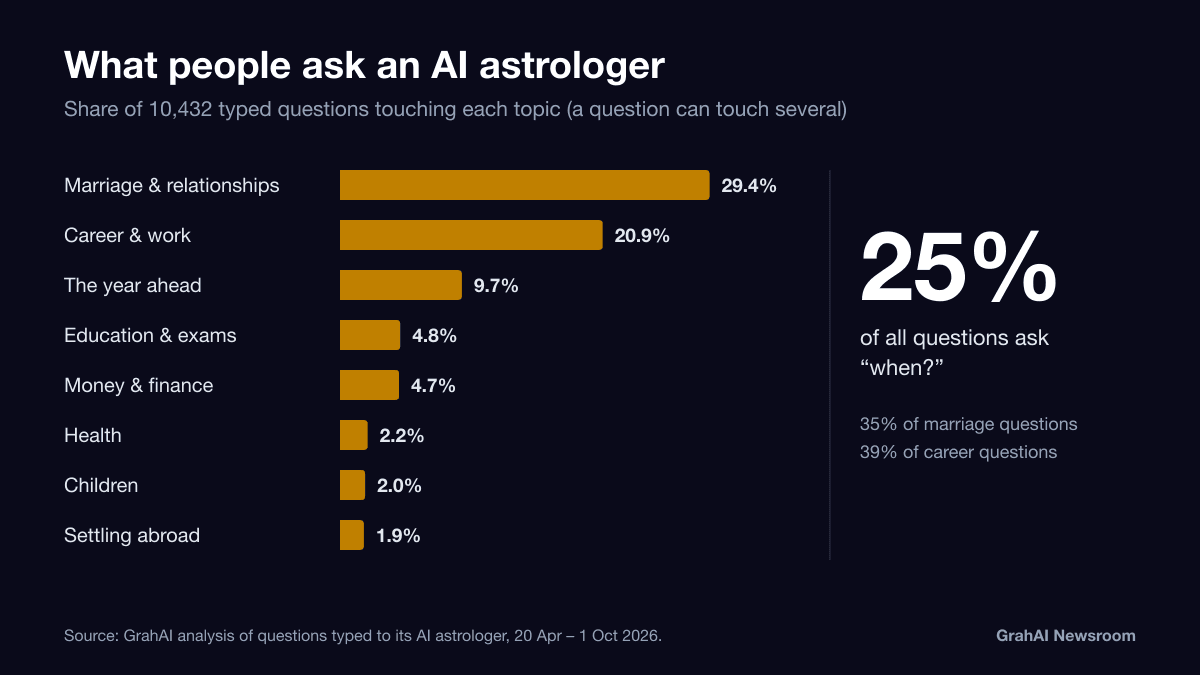
Between 20 April and 1 October 2026, people typed 10,432 questions to GrahAI’s AI astrologer. Marriage comes up in nearly three questions in ten and career in one in five — and one question in four asks not what will happen, but when.
| Topic | Share of questions |
|---|---|
| Marriage & relationships | 29.4% |
| Career & work | 20.9% |
| The year ahead | 9.7% |
| Education & exams | 4.8% |
| Money & finance | 4.7% |
| Health | 2.2% |
| Children | 2.0% |
| Settling abroad | 1.9% |
| Transits (Saturn, Rahu, Jupiter…) | 1.9% |
| Dasha periods | 1.6% |
| Remedies | 1.3% |
“When” is the question
25.2% of all questions ask about timing — when, which year, at what age, how long, or kab and kab tak. The share is higher inside the two subjects people raise most: 34.8% of marriage questions and 38.6% of career questions are timing questions.
Within career, 14.8% of questions mention government jobs (sarkari naukri) or the recruitment exams named for them — UPSC, SSC, PSC, bank PO and railway. Within marriage, 10.8% weigh a love marriage against an arranged one.
Hindi, typed in English letters
95.5% of questions were typed in the Latin alphabet. Among people using GrahAI in Hindi, 64.3% still typed their question in Roman script rather than Devanagari. Tamil and Telugu users split differently: 60.1% of questions from the Tamil interface were typed in Tamil script, and 46.5% from the Telugu interface in Telugu script.
Short questions, often just one
The median question is eight words long. Among signed-in users, 38.8% asked exactly one question in the period.
How the analysis was done
- Data: every message sent to GrahAI’s AI astrologer from 20 April to 1 October 2026, excluding GrahAI’s own internal and test accounts — 16,729 messages.
- Typed questions only: 6,297 messages (37.6%) were one of 23 suggestion buttons or pre-filled prompts — text sent word-for-word by 20 or more different people. They were removed, leaving 10,432 questions people wrote themselves.
- Topics: each question was matched against fixed keyword lists in English and common Hinglish (shaadi, naukri, padhai and so on) — the same lists GrahAI’s chat uses to recognise a subject. No AI model classified the questions, and no person read them.
- Timing: when, which year, what age, how long, by when, till when, kab, kab tak, kitne saal and their Devanagari forms.
- Script: each question was classified by the alphabet it was typed in; the interface language is the one the person had selected.
- Privacy: no question is quoted in this article. Every figure is a count across hundreds or thousands of messages.
Limitations
- These are GrahAI users, mostly in India — not a sample of everyone who consults astrology.
- Usage grew quickly: 63% of the questions arrived in September 2026, so the mix reflects recent users more than early ones.
- What people ask is shaped by how they arrived. Someone landing from a career page is more likely to ask about career.
- Keyword matching misses questions phrased other ways and is weakest for questions typed in Indian scripts; 39% of questions matched no topic.
- 74% of questions were asked without signing in, so the number of different people cannot be counted; per-person figures cover the 1,281 signed-in users only.
- The script shares for Hindi, Tamil and Telugu rest on 516, 198 and 185 questions.
Questions about timing are answered from a chart’s dasha periods and transits; GrahAI’s marriage and career pages compute both from a date of birth.
How this article was made
The figures come from a read-only analysis script run against GrahAI’s own records for the fixed window above; the chart is drawn from the same output. Drafting was AI-assisted, every figure was checked against that output, and Rahul Dubey reviewed the article before publication.
Written by
Founder, GrahAI
Rahul Dubey is the founder of GrahAI. He leads the product — the chart engine, the AI-written reports and the free tools on this site — and writes the company’s announcements and product notes in this newsroom.